
Sacha Inchi Oil vs Flax Seed Oil
A comparative general-reading reference between Sacha Inchi oil and flaxseed oil, focused on omega content, fatty acid and amino acid profiles, and oil quality considerations.
Sacha Inchi oil Flaxseed oil Omega 3 Fatty acids Amino acids Comparison Vegetable oils
Sacha Inchi Oil vs Flax Seed Oil
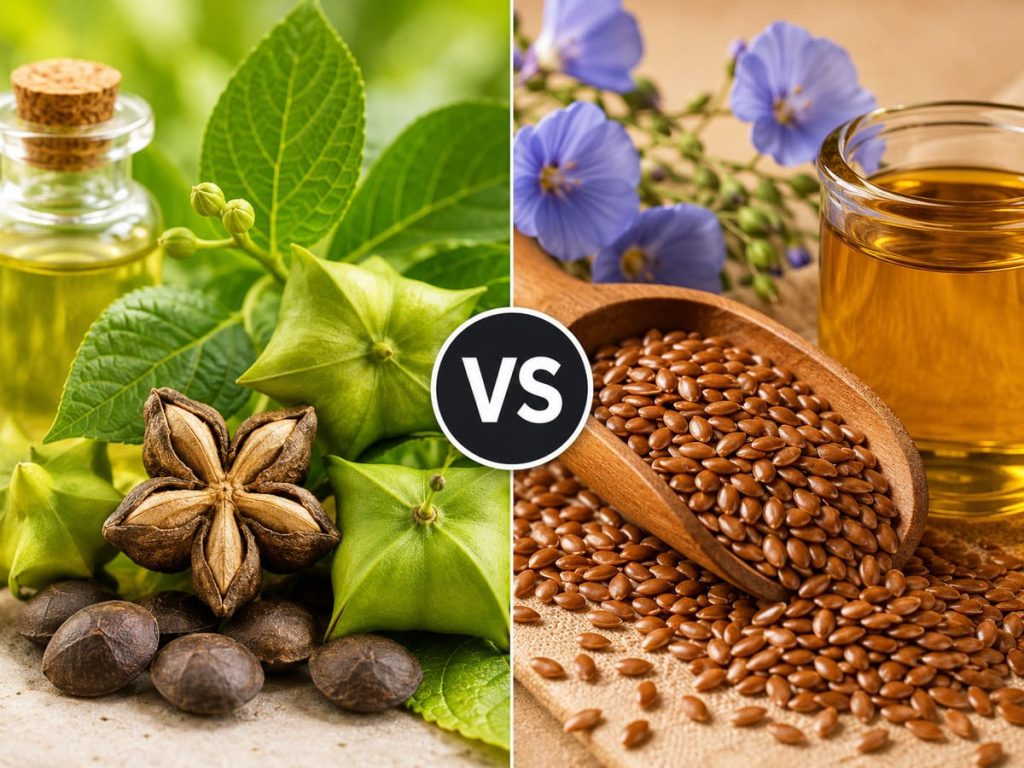
The flax seed is one of the best known vegetables of high Omega 3 content; it is even superior to the Sacha Inchi content, according to the study carried out by the “Universidad del País Vasco de España” and the “Universidad Agraria La Molina” de Lima, Peru.
Nevertheless, the Sacha Inchi Oil has advantages in relation to flax seed oil for the reasons and studies referred to below:
- The Sacha Inchi Oil is highly digestible, superior to the flax seed.
- The Sacha Inchi Oil contains natural antioxidants like alpha-tocopherol and beta-carotene.
- The Sacha Inchi Oil does not have the antinutrients that flax seed oil contains, which can interfere with the absorption of iron in the human body.
Comparison Between Sacha Inchi Oil and Flax Seed Oil
NMR and FAME-GC Methods
Source: Universidad del País Vasco, Faculty of Pharmacy, 01006 Victoria, España.
Universidad Agraria La Molina, Lima, Perú.
H NMR: 1H Nuclear Magnetic Resonance
Fat vs Fats — Sacha Barrio Healey Nutritional Medicine / Complemented by Sacha Inchi
| Sample | % Total Oil | % Linolenic Omega 3 | % Linoleic Omega 6 | % Oleic | % Saturated Fat |
|---|---|---|---|---|---|
| a. SI CrI (HNMR) | 52.80 | 47.40 | 39.30 | 6.10 | 7.20 |
| b. SI CrI (FAME-GC) | 48.50 | 51.50 | 34.50 | 8.90 | 5.00 |
| c. SI Cr2 (HNMR) | 52.40 | 47.60 | 38.50 | 6.30 | 7.50 |
| d. SI Re (HNMR) | 53.10 | 46.80 | 38.50 | 7.10 | 7.50 |
| e. SI Re (FAME-GC) | 46.70 | 53.30 | 33.70 | 7.90 | 5.00 |
| f. SI Ref Hamaker | 54.80 | 45.20 | 36.80 | 9.60 | 7.75 |
| Cr Study | 51.17 | 48.83 | 37.43 | 7.10 | 6.57 |
| SI Cr | 52.08 | 47.93 | 37.28 | 7.73 | 6.86 |
| General | 51.35 | 48.63 | 36.88 | 7.66 | 6.66 |
| Component | Sacha Inchi Plukenetia volubilis L. | Flax Seed Linum usitatissimum |
|---|---|---|
| Protein | 29.0% | 26.0% |
| Total Oil | 54.0% | 35.0% |
| Linoleic Acid O-6 Polyunsaturated | 36.8% – 38.2% | 14.0% |
| Oleic Acid Monounsaturated | 6.9% – 9.6% | — |
| Alpha Linolenic Acid O-3 | 45.2% – 48.9% | 58.0% |
| Saturated fatty | 6.8% – 7.7% | — |
Next, the characterization of the amino acids in the protein of diverse oleaginous seeds is presented. In this comparison, the superior characteristic of the Sacha Inchi can be seen clearly in respect to others, particularly to the flax seed.
Amino Acids Content in Protein, of the Principal Oleaginous Seeds
| Amino Acids | Sacha Inchi | Sunflower | Soya | Peanut | Cotton | Flax Seed | FAO / WHO / ONU |
|---|---|---|---|---|---|---|---|
| Total Proteins | 29 | 24 | 28 | 23 | 23 | 26 | — |
| Essential Amino Acids | |||||||
| Histidine | 26 | 23 | 25 | 24 | 27 | c | 19 |
| Isoleucine | 50 | 43 | 45 | 34 | 33 | c | 28 |
| Leucine | 64 | 64 | 78 | 64 | 59 | c | 66 |
| Lisine | 43 | 36 | 54 | 35 | 44 | b | 58 |
| Methionine | 12 | 15 | 13 | 12 | 13 | b | — |
| Cysteine | 25 | 15 | 13 | 13 | 16 | — | — |
| Methionine + cysteine | 37 | 34 | 26 | 25 | 29 | — | 25 |
| Phenylalanine | 24 | 15 | 49 | 50 | 52 | c | — |
| Tyrosine | 55 | 19 | 31 | 39 | 29 | — | — |
| Phenylalanine + tyrosine | 79 | 54 | 80 | 89 | 81 | — | 63 |
| Threonine | 43 | 37 | 39 | 26 | 33 | c | 34 |
| Tryptophan | 29 | 14 | 13 | 10 | 13 | c | 11 |
| Valine | 40 | 51 | 48 | 42 | 46 | c | 35 |
| Non Essential Amino Acids | |||||||
| Alanine | 36 | 42 | 43 | 39 | 41 | — | — |
| Arginine | 55 | 80 | 72 | 112 | 112 | c | — |
| Asparagine | 111 | 93 | 117 | 114 | 94 | — | — |
| Glutamine | 133 | 218 | 187 | 183 | 200 | — | — |
| Glycine | 118 | 54 | 42 | 56 | 42 | — | — |
| Proline | 48 | 45 | 55 | 44 | 38 | — | — |
| Serine | 64 | 43 | 51 | 48 | 44 | — | — |
| TEAA* | 411 | 332 | 408 | 349 | 365 | — | — |
| TAA** | 976 | 907 | 975 | 945 | 938 | — | — |
| TEAA (% de TAA) | 42 | 37 | 42 | 37 | 39 | — | — |
Source: Hamaker et al. 1992. Arkansas University, USA. Complemented with Sacha Inchi.
*TEAA: Total Essential Amino Acids
**TAA: Total Amino Acids
- The values are indicated in milligrams of proteins.
- Values for soya bean, peanut, cotton and sunflower have been taken from Bowell y Hopkins (1985).
- Recommended levels for pre-school aged children (2–5 years). Recently it has been recommended to evaluate the quality of the protein diet for all groups, with the exception of infants. (Consultant’s Meetings). Union of Expert Consultants of the FAO/WHO 1990.
- C = contains; b = lower content, but the value is not available.
Authorized quotations to conclude the comparison
- The flax seed has been strongly questioned as far as the amount of factors that interfere in the normal development of people and animals. The flax seed is used essentially to manufacture industrial products such as coatings, floor coverings, paintings and varnishes.
- The restriction in the use of flax seed in human and animal consumption is due mainly to the toxic presence of cyanoglycoside linamarin and antagonist factors of the B6 vitamin (Neffer, 2000; Center for Alternative Plant and Animal Products, 1995; Stitt, 1989; Butler et al., 1965). Recent discoveries demonstrate that low levels of vitamin B6 in the blood are associated with increasing risk of fatal cardiovascular disease and apoplexy (American Heart Association, 1999). Homocysteine, a non-protein substance, is considered a sulfur amino acid and is not a normal diet component. Homocysteine increases when folic acid and vitamin B6 are inadequate (Herzlich et al., 1996; Selhub et al., 1996). The researchers believe that when the corporal cells release excessive homocysteine in the blood, the interior of the arterial walls becomes irritated, stimulating the formation of fat deposit-plates which adhere in the arterial walls (McBride, 1999). Today it is recognized that high concentration of homocysteine in serum becomes a considerable high risk, besides cardiovascular diseases and apoplexy (Malinow, 1996; Boushey et al., 1995).
- All the varieties of flax seeds contain anti-nutritional factors, including the new variety FP087, a genetically modified organism (GMO), that has a concentration of total cyanogenic compounds (linamarin, linustatinase and total neolinustatinase), which are not different to the traditional ones (Canadian Food Inspection Agency, 1998).
- The human consumption of flax seed is prohibited in France and Germany, Switzerland and Belgium; it is used with limitations (Le Conseil d’Etat, 1973). In the United States, although human consumption is not prohibited, it does not have FDA approval. This signifies that under those circumstances, if a company decides to include the flax seeds in the formulation of a nutritional product, it will be responsible for any harm that may be caused (Vanderven, 1996).
- Recent research works in animals have warned on the negative action defined as the during pregnancy and the reproductive period. These effects have been attributed to the denominator diglucoside secoisolariciresinol (SDG) compound (SDG), that through the bacterial action, acts in the mammals as an estrogenic depressor or stimulant. The flax seed is known as the richest source of SDG and therefore it is recommended to take special care when its consumption takes place during pregnancy and lactation (Touge et al., 1998; Rickard y Thompson, 1998).
- Due to the flax seeds availability as industrial oil and its relatively low price, there have been several attempts to use it in the animal feeds as a source of fatty acids Omega 3, but without much success. Numerous scientific publications have demonstrated the negative effects caused by the flax seed’s anti-nutritional factor.
Related Insights