
The Sacha Inchi
A technical general-reading reference on Sacha Inchi botanical identity, oil composition, protein and amino acid content, fatty acid composition and nutritional qualities.
Plukenetia volubilis Botanical identity Sacha Inchi oil Protein Amino acids Fatty acids Nutritional composition
The Sacha Inchi
Plukenetia volubilis Linneo.
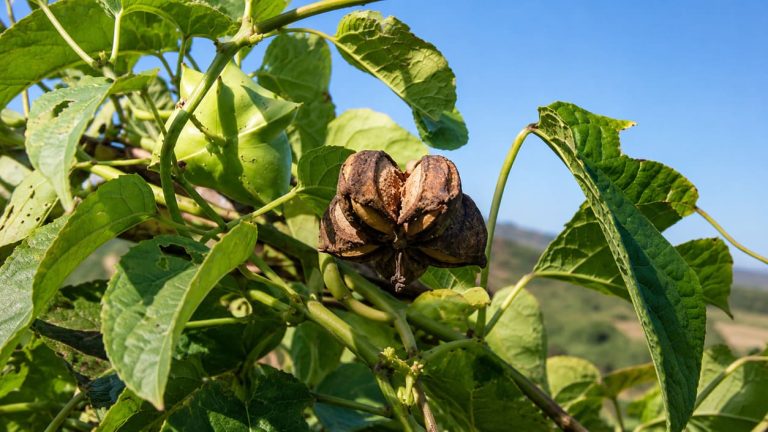
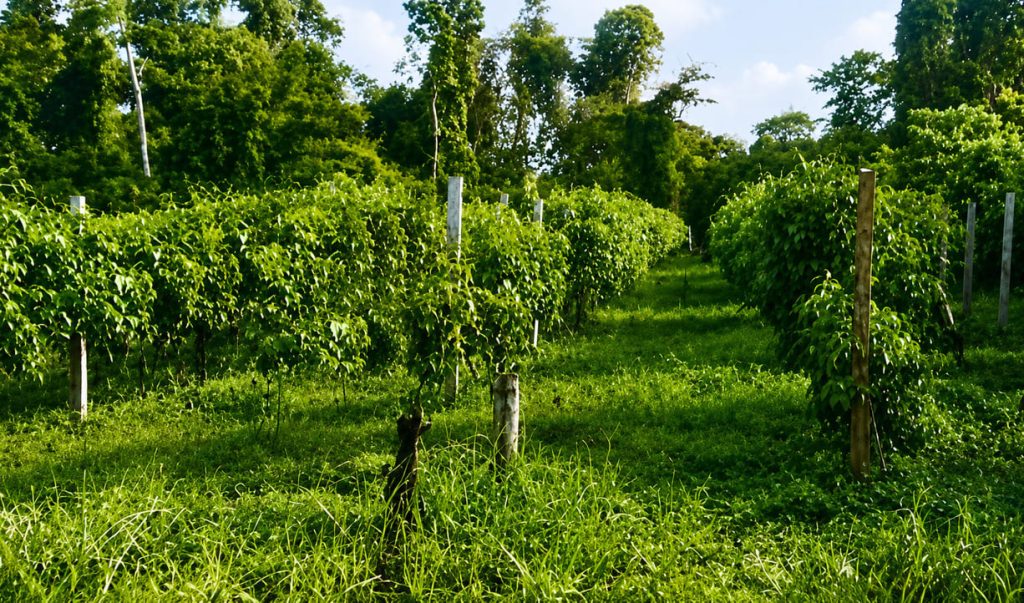
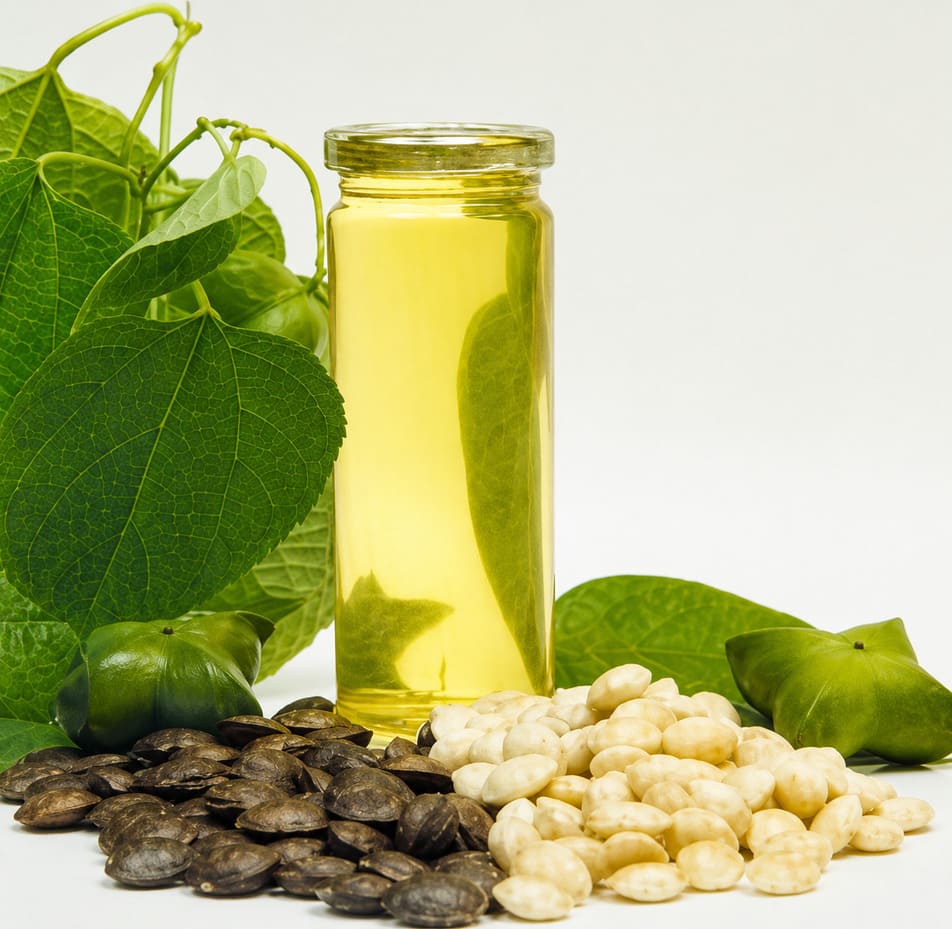
The SACHA INCHI, Plukenetia volubilis Linneo, is a wild climber oleaginous plant which grows mainly in the rainforest. It constitutes a great contribution of the Peruvian Amazon for the World.
“The Sacha Inchi is not an adapted specie, but it is rather a magnificent expression of the ecological environment in which it grows in a constant biological interaction amongst other plants, climate and soil” (MARTÍNEZ, 1979); it contains a high level of oil and proteins. Ceramics in the pre-Inca and Inca tombs give evidence of the SACHA INCHI seeds.
Botanical definition
Euphorbia
Euphorbiaceae
Plukenetia
Volubilis linneo
Sacha Inchi
Plukenetia volubilis L.
When studying the botanical family Euphorbiaceae, with more than 6,000 species and with extreme botanical and chemical diversity, of which the primitive society has used hundreds, it is logical to understand why the human being had taken into consideration their great economic importance.
The Euphorbia, that take the name of Euphorbio, the King of Juba, Medical Doctor in Mauritania (54 B.C.) — first in using the latex of these plants — which present a great diversity of compounds such as fat, fatty acids, esters and oils (“castor oil”, “curcas oil”, “essang oil”, “jiche oil” and others) (PEREZ–ARBELAEZ, 1956).
The gender Plukenetia has been reported in Malaysia, New Guinea, Mexico, etc. (Orton Commemorative Library, 1987). In Tropical America the number of reported species varies from 7 to 12 (Stanley and Steyermark, 1949; Hutchinson, 1969). In South America, the presence of Plukenetia volubilis Linneo has been registered in the Peruvian Amazon (Macbride, 1951).
This investigation began in 1988 and it has been retaken by the Program of Investigation in Genetic Resources and Biotechnology, at “El Porvenir” Experimental Station in San Martin, Peru, in the line of Genetic Improvement, compiling information about diverse cultivation forms and modalities, as well as the compilation and eco-types evaluation of Plukenetia volubilis L.
The Sacha Inchi Oil
Analysis carried out in the Institute of the Food Science at Cornell University USA (D.C. Hazen and Y. Stoewsand, unpublished data), established that the Sacha Inchi contains an unusual high level of oil (49%) and a relatively high content of proteins (33%) (Hamaker et al., 1992).
As a result of the studies carried out since 1980 in Peru, as well as in the United States and in other countries, it is known that this oil is the best among other vegetable oils used for human consumption; its rich composition of fatty acids demonstrates its high quality, included the polyunsaturated fatty acids of the Omega Group, in a higher content in comparison to other oleaginous seeds used for the extraction of oil for human consumption.
The Sacha Inchi seed oil has a high content of the linolenic fatty acid, the most valuable oil of the Omega Group present in the composition of the fats.
| Crop | Protein % | Fat % |
|---|---|---|
| Sacha Inchi | 33.3 | 48.7 |
| Soya bean | 28.2 | 18.9 |
| Peanut | 23.4 | 45.3 |
| Sunflower | 24.0 | 47.5 |
| Cotton | 32.9 | 16.1 |
| Palm Cruet | — | 45.0 |
Source: Hazen y Stoewsand, Cornell University Ithaca USA 1980; Duclos, P., Florida University, USA 1980.
The following chart shows the content of the fatty acids nutrients and the composition of several oleaginous seeds used for the oil production for the human consumption. The analyses and studies made on these seeds demonstrate in all aspects the high quality and superiority of the oil and the nutrients of the Sacha Inchi.
| Fatty Acids | Seed | ||||
|---|---|---|---|---|---|
| Sacha Inchi | Soya bean | Peanut | Cotton | Sunflower | |
| Total Oil (%) | 54 | 19 | 45 | 16 | 48 |
| Saturated | |||||
| C14 : Miristic | 0.0 | 0.0 | 0.0 | 0.0 | 0.0 |
| C16 : Palmitic | 4.5 | 10.5 | 12.0 | 18.7 | 7.5 |
| C18 : Stearic | 3.2 | 3.2 | 2.2 | 2.4 | 5.3 |
| Unsaturated | |||||
| C16 : Palmitic Oleic | 0.0 | 0.0 | 0.3 | 0.6 | 0.0 |
| C18 : Oleic | 9.6 | 22.3 | 41.3 | 18.7 | 29.3 |
| C18 : Linoleic | 36.8 | 54.5 | 36.8 | 57.5 | 57.9 |
| C18 : Linolenic | 45.2 | 8.3 | 0.0 | 0.5 | 0.0 |
| C20 : Gadoleic | 0.0 | 0.0 | 1.1 | 0.0 | 0.0 |
Source: Hazen y Stoewsand, 1980, Cornell University, Ithaca USA.
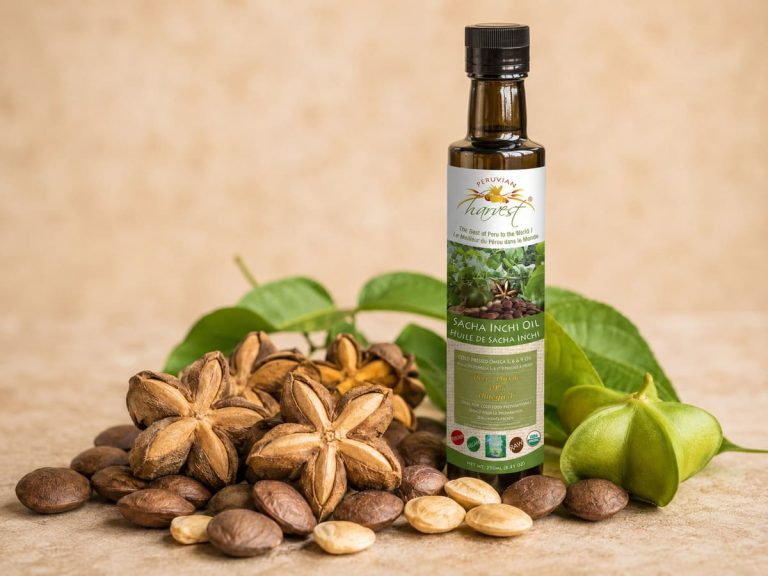
There are oils, pressed in cold, which have not been processed and do not contain any chemical additive, as it is the case of the Sacha Inchi Oil in its first extractive form; and therefore it is beneficial for the human organism.
This type of oil should only be used cold; that is to say, taking it directly from the bottle, in salads, mixed with yogurt or milk, or it can also be sprinkled on previously cooked meals. This is the recommended way to consume the extracted pressed in cold product in this extraction state pressed in cold.
In the alimentation, the contribution of Wira Sacha Inchi Omega Oil of Sacha Inchi in its diverse forms — due to its high protein, mineral and vitamins compounds — has become as the best oil for the domestic, industrial, cosmetic and medicinal human consumption.
The Sacha Inchi Proteins and Its Digestibility
The total proteins of the Sacha Inchi in comparison with the patterns recommended by FAO/WHO/ONU for the feeding of children in pre-school age, from two to five years, and what it has recently been recommended for all the ages, excluding infants, demonstrate an interesting nutritional profile.
| Proteins and Amino Acids | Sacha Inchi | Soya bean | Peanut | Cotton | Sunflower | FAO/WHO/ONU |
|---|---|---|---|---|---|---|
| Proteins | 27 | 28 | 23 | 23 | 24 | — |
| Essential Amino Acids | ||||||
| Histidine | 26 | 25 | 24 | 27 | 23 | 19 |
| Isoleucine | 50 | 45 | 34 | 33 | 43 | 28 |
| Leucine | 64 | 78 | 64 | 59 | 64 | 66 |
| Lisine | 43 | 54 | 35 | 44 | 36 | 58 |
| Methionine | 12 | 13 | 12 | 13 | 15 | — |
| Cysteine | 25 | 13 | 13 | 18 | 15 | — |
| Methionine + cysteine | 37 | 26 | 25 | 29 | 34 | 25 |
| Phenylalanine | 24 | 49 | 50 | 52 | 15 | — |
| Tyrosine | 55 | 31 | 39 | 29 | 19 | — |
| Phenylalanine + tyrosine | 79 | 80 | 89 | 81 | 54 | 63 |
| Threonine | 43 | 39 | 26 | 33 | 37 | 34 |
| Triptophan | 29 | 13 | 10 | 13 | 14 | 11 |
| Valine | 40 | 48 | 42 | 48 | 51 | 35 |
| Non Essential Amino Acids | ||||||
| Alanine | 36 | 43 | 39 | 41 | 42 | — |
| Arginine | 55 | 72 | 112 | 112 | 80 | — |
| Asparagine | 111 | 117 | 114 | 94 | 93 | — |
| Glutamine | 133 | 187 | 183 | 200 | 218 | — |
| Glycine | 118 | 42 | 58 | 42 | 54 | — |
| Proline | 48 | 55 | 44 | 38 | 45 | — |
| Serine | 64 | 51 | 48 | 44 | 43 | — |
| TEAA* | 411 | 418 | 349 | 365 | 366 | — |
| TAA** | 976 | 985 | 945 | 938 | 941 | — |
| TEAA (% de TAA) | 42 | 42 | 37 | 39 | 39 | — |
Source: Hamaker et al. 1992, Arkansas University, USA.
*TEAA: Total essential amino acids
**TAA: Total of amino acids
- The values are indicated in milligrams of proteins.
- Values for soya, peanut, cotton and sunflower were taken from Bodwell and Hopkins (1985).
- Recommended levels for pre-school children (2–5 years). Recently it is recommended for the evaluation of the protein diet quality for all groups, with the exception of infants (consultant meeting, Group of Experts FAO/WHO 1990).
Digestibility of products derived from Sacha Inchi
The results of the Sacha Inchi digestibility, mainly for its flour and oil products, are as follows:
- In the flour scoured by a pressing process, it was obtained a real protein digestibility of 92.24 versus 94.42 of casein, used as a control reference.
- For the oil, it was proven a digestibility with the following results:
casein + 10% of vegetable oil 88.0
casein + 10% of Sacha Inchi oil 93.7
casein + 15% of vegetable oil 91.8
casein + 15% of Sacha Inchi oil 96.4
Source: The absorption of the oil is quite high and definitely better than a commercial vegetable oil. This study was carried out for the Thesis of Degree from the Engineer Liley Velis Saavedra of the Universidad Nacional de San Martín, Agroindustrial Engineering Faculty, being sponsor by the Engineer Ernesto Santander Ruiz. The analyses were carried out in the Instituto Nacional de Nutrición, Lima-Peru.
The Omega 3 and 6 of the Sacha Inchi Oils
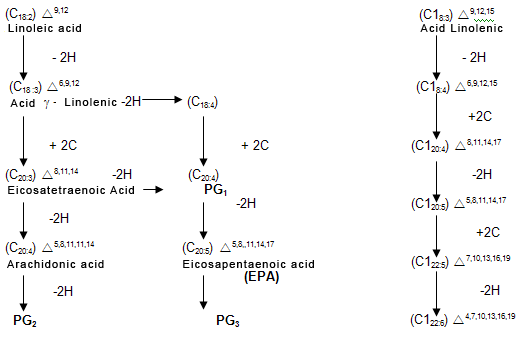
The linoleic acid (C18:2 w6) and alpha-linolenic (C18:3 w3) are essential because the human being cannot insert double bonds due to the lack of enzymes responsible for the introduction of double bonds in the positions w6 and w3.
When the organism assimilates the essential acids fatty linoleic and alpha-linolenic, through the “Desaturase” enzyme, elongates them converting the linoleic chain from “18 atoms” of carbon with two double bonds into “20 atoms” with 5 double bonds producing the fatty acid Eicosapentaenoic EPA; the chain of the alpha linolenic elongates from “18 atoms” of carbon with 3 double bonds to “22 atoms” with 6 double bonds producing the fatty acid Docosahexaenoic DHA. These fatty acids are denominated Omega-3.
From the linoleic and alpha-linolenic acids, through the elongation and desaturation process from the chains of atoms of carbon, the polyunsaturated fatty acids of very long chain are synthesized by the organism.
The fatty acids of each family cannot be converted between themselves. Therefore, it is of fundamental importance that the synthesis of the different polyunsaturated fatty acids of a very long chain depends directly on the respective precursors concentration and a correctly balanced contribution.
The Omega-3 oils are very rare in nature and they are indispensable for life and health, that is why they should always be present in the diet; especially the Omega-3 alpha linolenic, as it cannot be synthesized from the ingested food by the organism, for this reason it is denominated the “essential linolenic fatty acid.”
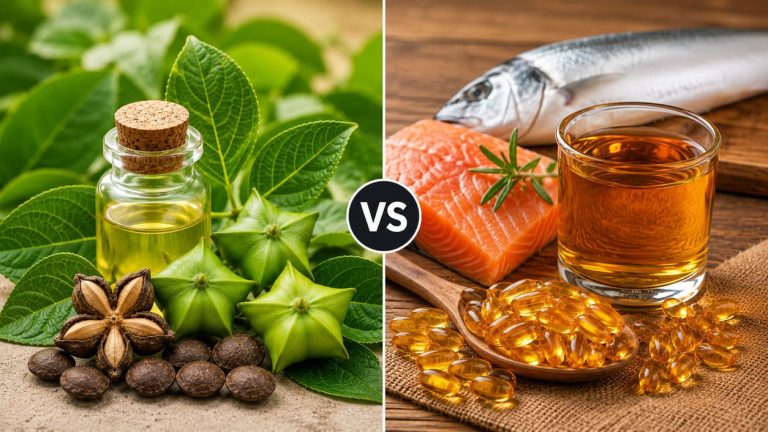
The Omega-3 EPA and DHA are in the seaweeds, which are consumed by some fish of cold waters. The human organism synthesizes the elongation process of EPA and DHA fatty acids, from the essential linoleic acid and the linolenic (source: Marino Villavicencio Núñez, Biochemistry 1996), contained as well as in the Sacha Inchi Oil; being one of the most prospective nutritional sources to promote good health.
Synthesis of Essential Polyunsaturated Fatty Acids
PG = prostaglandin
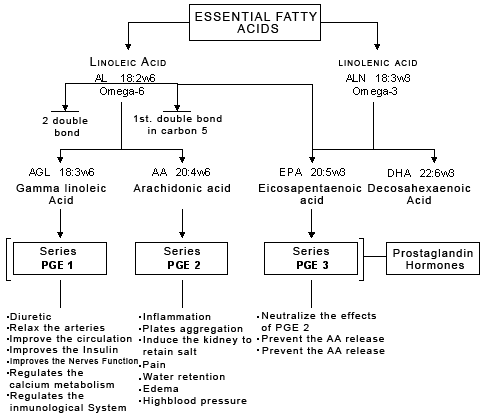
Nutritional sources
The main nutritional sources of essential fatty acids are:
Omega 6
The linoleic (n-6): the Sacha Inchi, cardamom, sunflower, soya bean, corn, sesame and most of the grains. The Gamma Linolenic Acid GLA (n-6), the primrose and the borage (evening primrose oil and borage oil). Due to its therapeutic benefits GLA is indicated in many other conditions of health that includes clinically: the arthritis rheumatoid, cardiovascular diseases, diabetic neuropathy, cancer, and skin illnesses such as eczema and psoriasis.
Omega 3
The alpha-linolenic acid ALA (n-3): it is in the Sacha Inchi and in the flax seed; and in a very small proportion, in the soya bean, nut, and the pumpkin seed. The Docosahexaenoic DHA and the Eicosapentaenoic Acid EPA that can be obtained directly of the oil extracted from the cold water fish, mainly salmon, mackerel, anchovy, sardine, cod. The investigation demonstrates that the fish fat which contains EPA and DHA has therapeutic benefits in areas including: arthritis rheumatoid, high triglycerides in the blood, high pressure tension, heart arrhythmia, the development of the child’s brain and cancer.
Gabe Mirkin M.D. indicates that since the human being inhabits the earth, food containing Omega-6 and Omega-3 has been ingested in a proportion of approximately 1 to 1. However, during the last 50 years, especially in North America, the proportion has changed from 2 to 1, to 10 or 20 to 1.
The diet of the North Americans includes big quantities of oils extracted from plants, which are used to cook or to prepare the meals. These oils, such as corn, sunflower, cotton seed, peanut, or soya bean, are mainly Omega-6. It has diminished the ingestion of Omega-3, which mainly comes from the whole grains, beans, other seeds and from the seafood, shellfish and fish.
The ingestion of too much Omega-6 and very little Omega-3 causes clots and it narrows the arteries, increasing the risk of heart attacks; swellings and increment of the arthritis; increase the risk of skin diseases, such as psoriasis. It can block the ability of a person to respond to insulin, causing high insulin and high levels of sugar in the blood and the obesity. The increase of levels of the insulin hormone, as the “factor of growth”-1, causes certain types of cancer.
In order to achieve the right proportion of Omega-6 / Omega-3 in a healthy “2 to 1” ratio, one should eat seafood, whole grains, beans and other seeds; and should reduce the ingestion of made or cooked meals with vegetable oils.
The Sacha Inchi and their derived products have become today an excellent alternative vegetable source of Omega-3 and now they have obtained a relation “2:1” – “4:1” that is the same as the one in the maternal milk. Alpha-linolenic Omega-3, main compounds of the Sacha Inchi Oil to 85.41%, are essential and should be consumed in the feeding.
The Sacha Inchi Oil Market
National Market (Potential – Future)
Contribution to the national nutrition with rich products in Omega 3 for human consumption. Special programs have to be designed and promoted, taking into account the protein concentration of the Sacha Inchi cake.
International Market
- Japan: Food Industry Trading for human consumption, in volumes, which are increasing according to the oil and protein Omega cakes production.
- USA: As ingredients for the food industry in the North American market.
- Europe: Omega oil for medicinal use and for the food industry; protein cakes for human consumption. Also for cosmetic use.
Related Insights